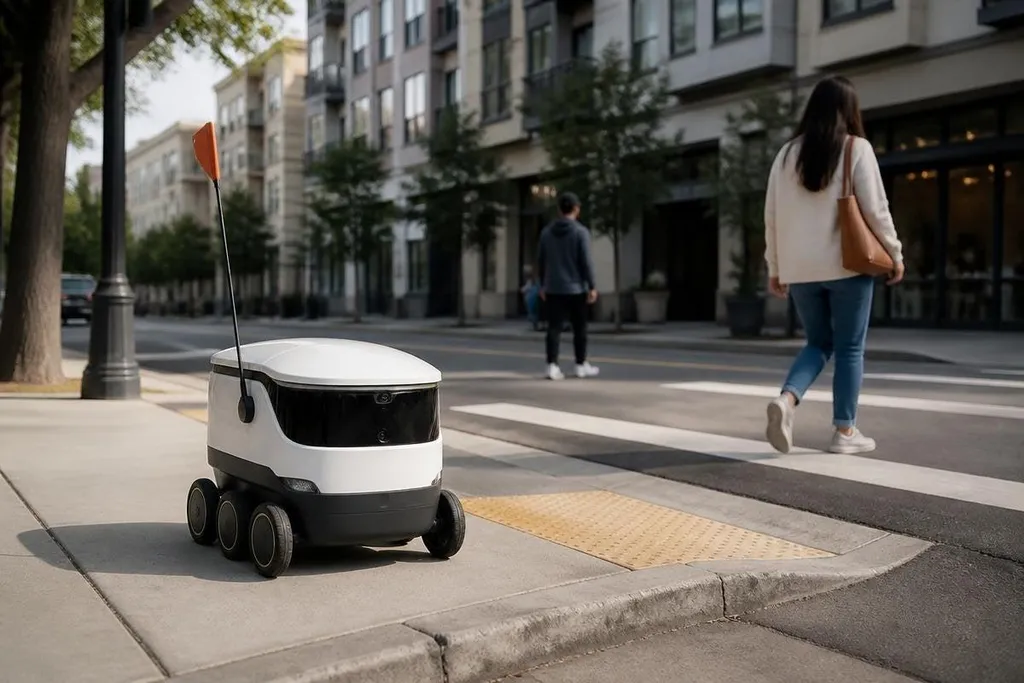
A delivery robot needs to do more than carry a box from one address to another. It must spot people, read kerbs and crossings, choose a safe route, and ask for help when its sensors disagree.
AI now handles more of that work, but the hard part remains the same: getting a small machine through a busy public space without stopping every few metres.
Quick read
- AI helps the robot read cameras, LiDAR, GPS, and wheel data together.
- Route software can react to blocked paths instead of following one fixed map.
- Human support still matters when weather, crowds, or damaged pavements confuse the robot.
Seeing the route
The robot builds its view from several sensors. Cameras record colour and shape. LiDAR measures distance with laser pulses. Wheel encoders report how far the drive wheels have turned, while GPS gives a rough outdoor position.
AI software compares these inputs and labels objects such as people, bicycles, parked cars, kerbs, and road signs. That label changes the robot's next move. A person walking across the path may cause a short wait, while a kerb may force a route change.
The useful part is the link between seeing and acting. A camera may spot a dark patch on the pavement, but the robot still needs to decide if it is a shadow, a hole, or a wet surface. More training examples can help, though they don't remove the need for sensible speed limits and safe stop rules.
Choosing a route
Older delivery systems can rely on a fixed map with marked drop-off points. AI can help the robot compare that map with what it sees now. A blocked footpath, a temporary barrier, or a group leaving a station may change the best route.
That decision happens in short cycles. The robot checks its position, looks for obstacles, estimates how much space it needs, then sends new speed and steering commands to its motors. The system may run on the robot's computer, on a remote server, or across both, depending on the design.
The choice affects service. A robot that waits for a remote answer during every uncertain moment will feel slow and may stop when its wireless link drops. A robot that makes every decision alone may handle routine paths well but need a human operator for unusual scenes.
A delivery robot may reach the right door and still fail when a lift is busy or a customer blocks its path. Reports on delivery robots from Robot24.com can show how the system handled that scene, who took control, and what the trial measured. Those cases lead into the limits AI still faces.
Where AI still struggles
Public paths are messy. Rain can reduce camera detail, bright sunlight can affect images, and snow can hide the edge of a kerb. Construction work can also make a map wrong before the robot has a chance to update it.
People create harder cases. Someone may stand in front of the robot, move aside, then step back into its path. A dog can change direction without warning. The robot needs a safe response for each case, not a clever-looking clip from a controlled test.
Remote support covers some of that gap. An operator can review a video feed, choose a route around an obstacle, or confirm that the robot may cross a marked area. That still leaves a cost for staff time, network access, and the rules that decide when the robot must stop.
The open question is performance outside the test route. A maker may show the robot completing one delivery, but that does not prove it can repeat the task through different weather, foot traffic, and pavement layouts.
A practical buying check
Before you assess a delivery robot for a site, check these points:
- Route limits: list the roads, pavements, crossings, slopes, and surfaces it can handle.
- Sensor plan: ask which cameras, LiDAR units, and position sensors it uses, plus what happens when one fails.
- Human support: find out when an operator takes control and how many robots one person can watch.
- Network loss: test the robot's response when its connection drops during a trip.
- Weather limits: ask for stated operating limits for rain, heat, cold, glare, and snow.
- Proof from trials: request results from repeated routes, not one prepared demonstration.
I'd wait for repeated route data before paying for a large delivery fleet. A robot that completes one trip is a demonstration; a service needs the same safe response every day.
The next useful proof will be simple: how many deliveries a robot completes without remote help, across a stated route and a stated range of weather.